
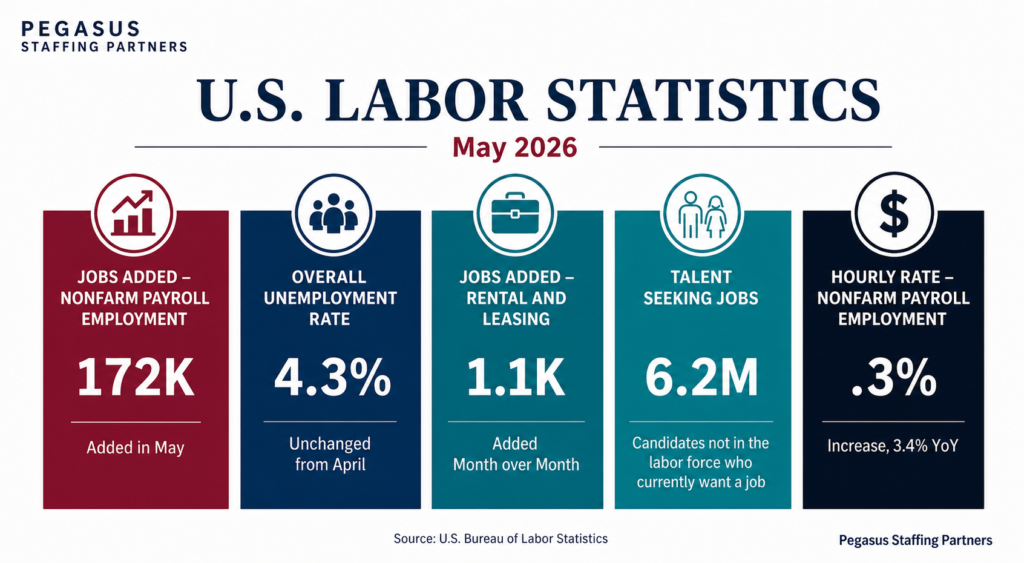
The May 2026 jobs report landed with a strong headline: 172,000 jobs added and unemployment holding at 4.3%. On paper, that’s a solid, steady labor market. Under the surface, though, we’re still in a cautious, “slow to move” environment that both candidates and employers in accounting, finance, HR, and operations are feeling every day.
For anyone trying to hire or make a career move right now, it’s important to understand both realities.
What May’s numbers actually say
First, the basics. According to the Bureau of Labor Statistics, employers added 172,000 jobs in May, roughly in line with April’s revised gain of 179,000, and the unemployment rate was unchanged at 4.3%. Revisions to March and April added another 93,000 jobs, which means the labor market has been consistently stronger than initially reported.
Job growth in May was fairly broad‑based:
- Leisure and hospitality, local government, and health care each added tens of thousands of jobs and were key drivers of overall gains.
- The private sector added around 120,000 jobs, while government payrolls rose by about 52,000 – the biggest government gain in nearly two years.
- Financial activities actually lost about 22,000 jobs in May and is down more than 100,000 jobs compared with a year ago.
Over the last three months, employers have added an average of roughly 188,000 jobs per month, a big improvement from the much slower pace a year earlier. In other words: the job market isn’t falling apart; it’s still expanding.
But that’s only half the story.
A “low‑hire, low‑fire” reality below the surface
Even with steady job growth, several details in the report point to a market that feels tight, slow, and cautious:
- The unemployment rate has been stuck between 4.3% and 4.5% since mid‑2025, suggesting the labor market has settled into a narrow band.
- The number of people jobless for 27 weeks or more (long‑term unemployed) is up over the past year, even though the headline unemployment rate is steady.
- Analysts describe the market as having “one strong headline, but two realities”: solid job creation alongside lingering slack and a meaningful share of jobseekers struggling to reconnect.
Put simply: companies are not laying people off in large numbers, but they’re also not hiring aggressively in every sector. Many are being highly selective, stretching existing teams, and taking their time to make decisions – especially for professional roles where each hire carries real cost and risk.
If you work in accounting, finance, HR, or operations, this is exactly what you’re feeling:
- There is demand for your skills, but hiring processes are longer and more selective.
- Companies are backfilling carefully and thinking hard about every net new headcount.
- Certain areas, like finance and financial services, are taking a more cautious stance even as other parts of the economy grow.
What this means if you’re a candidate
The numbers don’t say “don’t move”; they say “be strategic.”
Here is how to respond to a market that’s steady but cautious:
- Tighten your story. In a environment where employers can be choosy, you need a clear narrative about who you are and the value you create – especially around data, technology, and process improvement.
- Focus on alignment, not volume. With hiring managers being more selective, tailored applications to truly relevant roles will outperform “spray and pray” every time.
- Stay visible and connected. In a low‑hire, low‑fire world, moves often happen through relationships. Recruiters, past managers, and professional networks are still where a lot of opportunities start.
The May report tells you that jobs are still being created – just not in a way that rewards a passive job search.
What this means if you’re an employer
For employers, May’s numbers are a reminder that waiting for a “perfect” time to hire is risky.
- With unemployment holding at 4.3% and job gains running around 170-180k per month, you’re competing in a market where good people already have options, especially in critical functions.
- Sectors like financial activities are trimming headcount, which can create pockets of available talent – but that window won’t stay open forever.
- Stretching your accounting, finance, HR, and operations teams too thin while you “wait and see” can create burnout, turnover risk, and execution issues that are far more expensive than a well‑timed hire.
In this climate, smart employers are:
- Prioritizing truly critical roles and moving decisively on them.
- Using a blend of permanent and interim/contract solutions to manage workload without over‑committing.
- Calibrating compensation to 2026 realities instead of 2022 budgets, especially for high‑impact positions.
How I’m advising clients and candidates right now
When I look at May’s numbers, I see a labour market that’s resilient but cautious – and that calls for the same mindset from both sides of the table.
- For candidates in accounting, finance, HR, and operations: this is a time to step up your strategy, not step back.
- For employers: this is a time to protect your core teams and be intentional about the roles you do fill, not to freeze and hope workload problems solve themselves.
If you’re trying to navigate this environment – whether you’re exploring your next role or deciding how and when to add headcount – I’m happy to be a sounding board.
What’s one thing you’re noticing in your corner of the market that the May jobs report doesn’t fully capture?